
Direction

Quality education that does not look like studying.

RunRiva is an ecosystem for learning by playing. The same edited questions land in the classroom, on paper, on a phone, on YouTube and on television, and through the API in other people's apps too. This page says why we do it, what already works, what is still missing and where it is heading.

Why we do this

Education through entertainment and entertainment in education. What teaches is a question with immediate feedback - sometimes as a quiz, sometimes as an interactive presentation run live. The review by Dunlosky and co-authors (2013) ranks practice testing among the two learning techniques of highest utility, effective for learners of different ages, and Roediger and Karpicke (2006) showed it produces better recall after a week than rereading.

Running a quiz is the fun part. Writing the questions is the work - and that is the work we take off the host.
The same question, five forms

The same question, five forms. Switch the tabs: the content does not change, only the medium and what it can do. The first themed set built this way will be a financial education set for the people who teach - the question below comes from it.

Example questionlevel 2 of 5

You put aside 100 zloty a month into a savings account paying 5% a year. After a year you have:

  • Aa little more than 1,200 zloty
  • Bexactly 1,200 zloty
  • Ca little less than 1,200 zloty

The question sits inside a presentation slide. Participants answer from their phones after scanning a QR code, the host and the moderator each get their own view, and the same presentation goes from one link to the projector and to other computers.

Interest is added on top of the deposits. A child counts the deposits, a grandparent adds the interest and the tax. The same question works at two levels.

A question edited once lands in all of these places at once. That is the whole thesis of this studio.

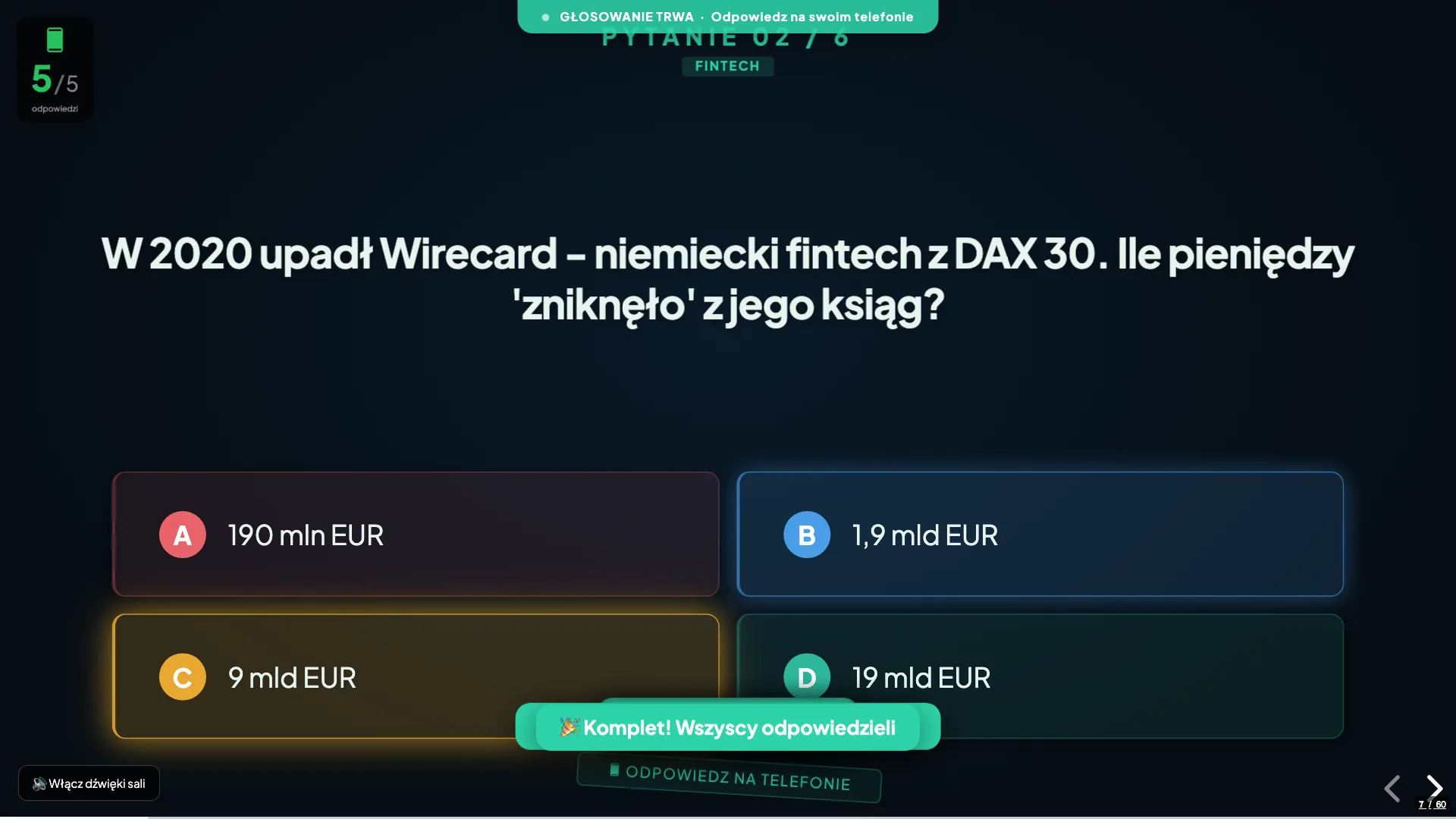
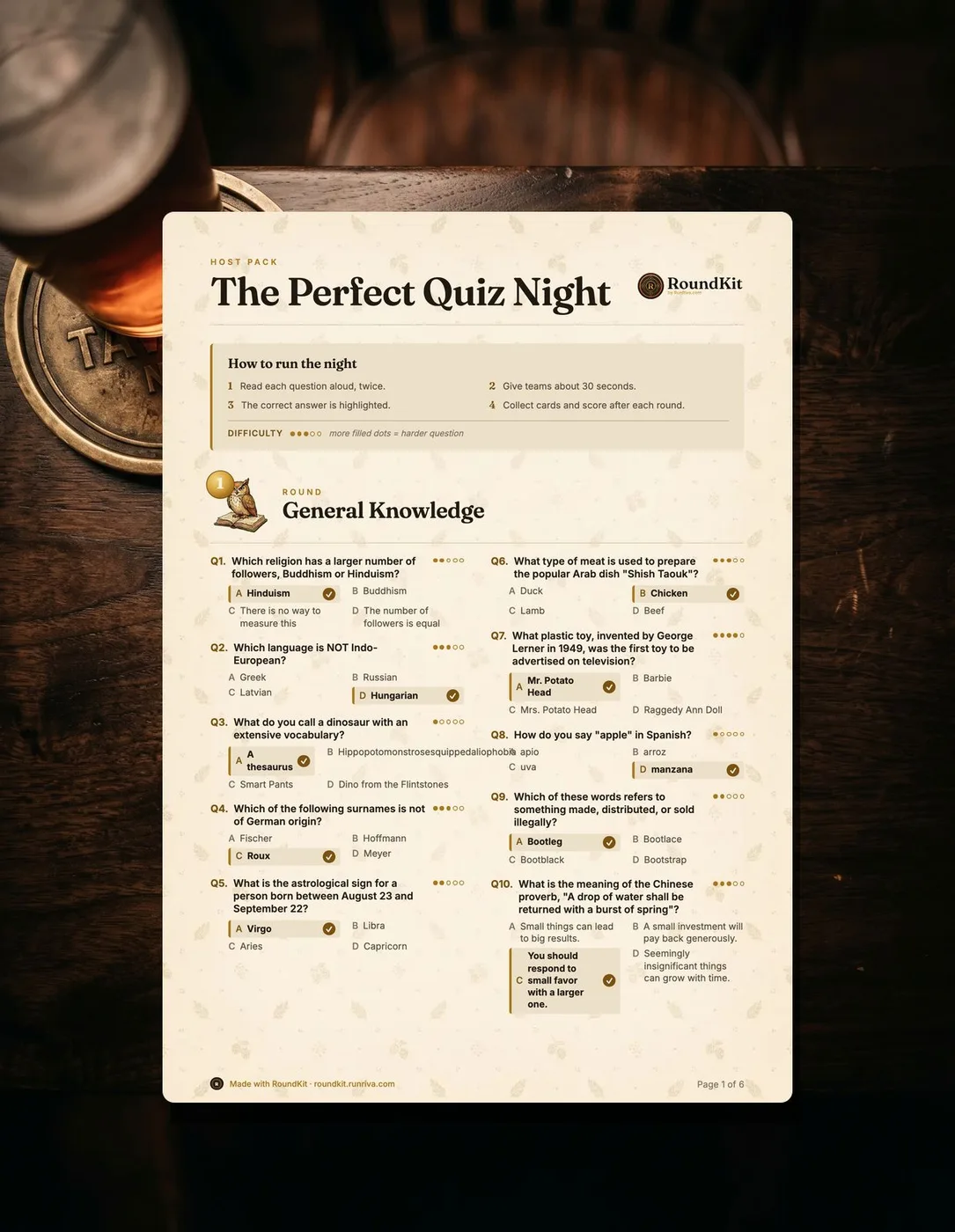
A quiz question on the projector during a live session A printed host pack with questions and space for answers A question inside the mobile app on a phone screen
Three of the five forms, in real screenshots: a question on the projector in the room, the host's printed pack, and the same thing inside a mobile app.

Where the questions come from

A base, not a generator. Over 1.1M questions in two languages, from eleven open datasets under free licences. Every record carries nine attribution fields: source, author, licence and the changes made - without a licence a question does not enter the base. Five difficulty levels were assigned by a language model in a single pass over the whole base, using the set of wrong answers as the signal.

1,173,456 questions in the base, as of 26 May 2026. Headlines say "over 1.1M" - this is the exact figure.

  • trivial 4.4%
  • easy 14.5%
  • medium 25.0%
  • hard 30.0%
  • expert 26.1%
Difficulty spread after calibrating the whole English pool.
"attribution": {
  "source": "opentriviaqa",
  "license": "CC-BY-SA-4.0"
}

Honestly: the Polish half of the base is high-quality machine translation today, and the content is entertainment, not schoolwork. Questions written in Polish, about Poland and about money, are what we build next.

Who this is for

Three generations, the same content, a different difficulty level and a different medium. Figures from public sources.

A child in the classroom

511k

teaching posts in preschools and schools (GUS, 2024/25)

A lesson run by a teacher or by a volunteer from a financial education programme. The participant answers from a phone or on paper - no account, nothing to install.

A parent at home

23.5%

of working Poles took part in education or training in 2024, against 32.1% across the EU (PIE, 2025)

The Sunday episode, or a game on the television where the phones in the room are the controllers. A topic broad enough for a child and a grandparent to play at the same table.

A senior at a university of the third age

126k

students at 747 universities of the third age (GUS, 2024/25)

A class run on a projector, with a printout for those who prefer paper to a screen. The same topic as in the classroom, at a different difficulty level.

What we do not require from a participant an account or an install - they join with a QR codea smartphone - there is a paper versionEnglish - the base is in two languagesa budget - a free API plan with no card, content under free licences

Honestly: the content today is entertainment translated from English, so it rarely suits a child. Questions written in Polish, about Poland and about money, are exactly what we build next.

For partners: our questions inside your app

Not everyone will install one more app. So the base goes outwards, and it can be placed where people already are.

API and library

REST with attribution in every response, a client library and an MCP server for AI assistants. Free plan, no card.

White label

Five of our mobile games run on one codebase - only the topic and the skin differ. The sixth could carry someone else's brand.

Ready components

Live sessions, printouts, trivia cards, leaderboards and seasons are parts, not separate products. An institution running an education programme can host the quiz itself.

What works and what does not

Five tools, four of them working. The state without dressing up - the same way we write it down for ourselves.

  • Live presentation works, by invitation I run corporate training on it. Access today is by invitation - opening it to anyone who creates their own account is the next step.
  • Print works RoundKit: packs for print and screen, in Polish and English. Payments have been live since June 2026.
  • Phone works Five single-topic games on Google Play, in Polish and English. iOS is deliberately on hold.
  • Episode works, in English RunRiva Quiz Show: forty questions per episode, hosted by Riva. The Polish version is still ahead of us.
  • Television in progress The television as the screen, the phones in the room as controllers. It also runs on a computer.

400participants in a single session at once, with no errors and no timeouts in a load test.

20 × 50concurrent sessions in the same test: a thousand people in twenty rooms, on one server instance.

Twelve months

This order is deliberate: content first, where the tools are already built; then the most expensive and riskiest thing, opening the platform to strangers; and measurement at the end, once there is something to measure. No promised dates.

  1. Content on the fast channels

    The financial education set starts where the tools are ready: questions after editorial review, printouts for hosts, episodes in Polish.

  2. App and first classrooms

    A mobile app carrying the financial set. First lessons in classrooms, run together with teachers, and a survey among players.

  3. Platform opened

    Teachers and volunteers create an account and run sessions without our help. A pilot with universities of the third age.

  4. Television and measurement

    The television game in a test version. A study with a delayed test, with the findings going back into the base and the tools.

What we are looking for

Three things, in this order. Educators, teachers and volunteers who will run a class on this tool and tell us what is wrong - a pilot with measurement is our first milestone, not our last. Partners who want our questions on their side: in their app, in their education programme, under their brand. And people to edit content in Polish, because that is the one thing a model cannot speed up.

This studio was not started in order to raise funding. It was started because running quizzes is fun and writing questions is work. Capital and partners speed things up, but they do not start anything here.